

A docking system must connect the device quickly, hold it in the correct position and maintain reliable electrical contact during daily use. For enterprise and professional equipment, the dock may also need to charge the device, synchronize data, update firmware or connect accessories.
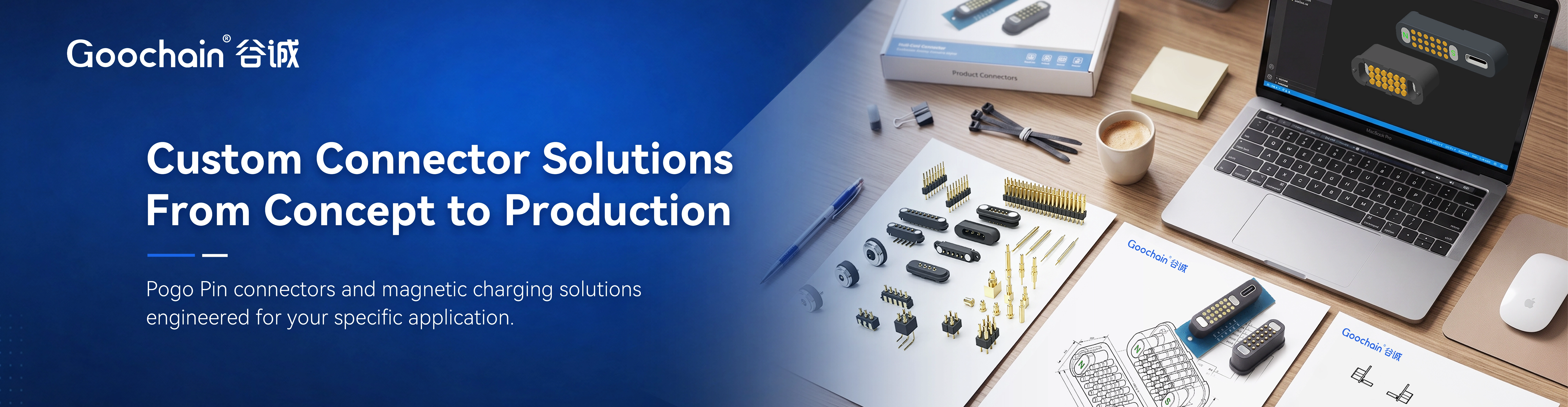
A custom magnetic Pogo Pin connector can combine these functions in a compact interface. Spring-loaded contacts accommodate the designed mating stroke, while magnets and mechanical guides help align the device with the dock.
For applications requiring large or frequent data transfers, the interconnect can be developed as part of a USB 5Gbps or USB 10Gbps channel. Explore Goochain's high-speed Pogo Pin connector solutions for the broader engineering platform.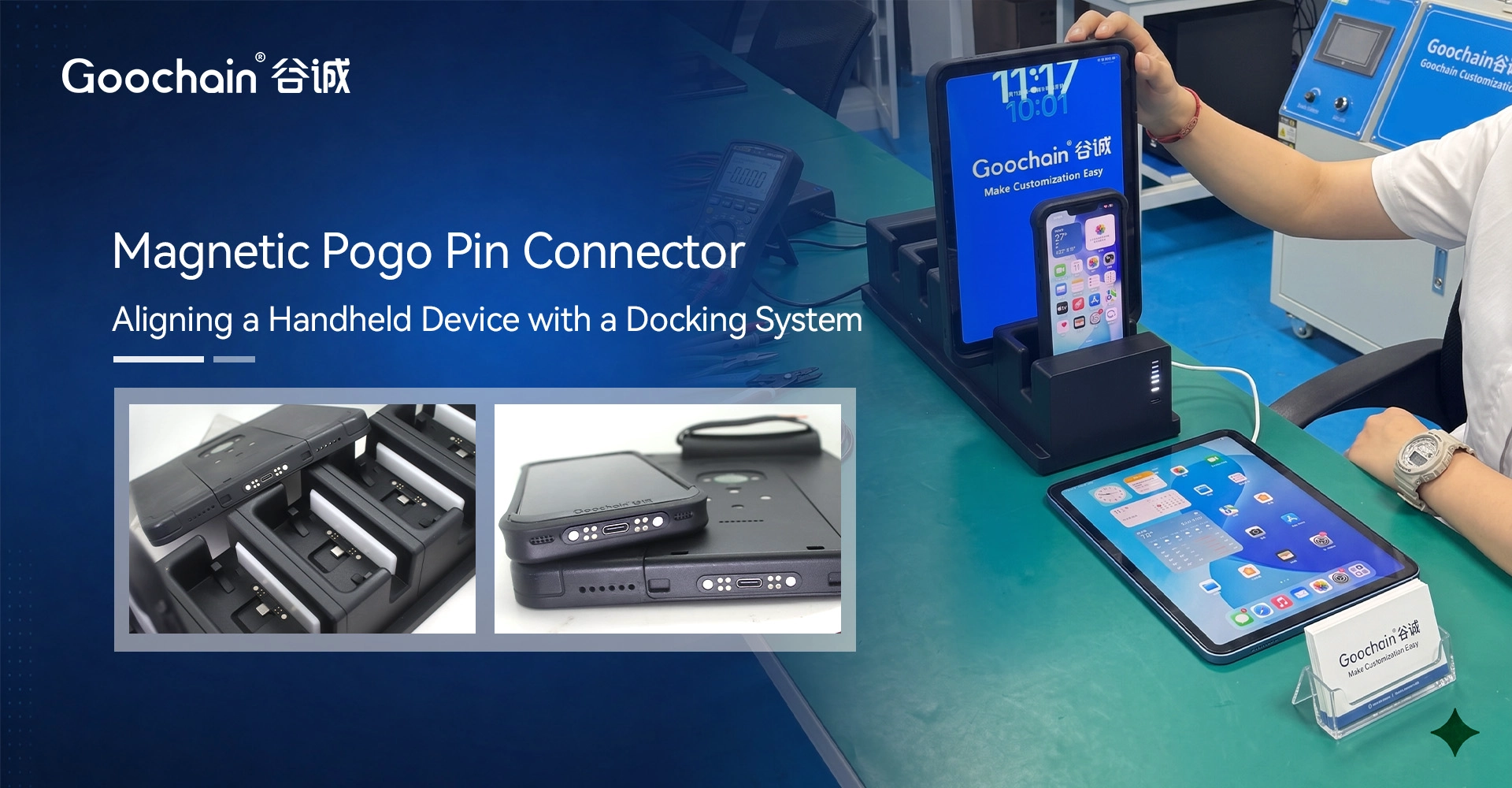
Fast Alignment
Magnets and mechanical features can guide the device into position. This reduces the need to locate and insert a small plug during every docking cycle.
Repeatable Contact
Spring-loaded contacts maintain the designed pressure across normal mechanical tolerances. The connector still requires correct working stroke, pad size, housing support and alignment.
Integrated Charging and Data
A multi-pin interface can assign separate contacts for power, USB data, ground and auxiliary signals. The exact pinout is customized for the device.
Reduced Handling of the Main Device Port
A dedicated dock interface can reduce repeated daily insertion into the device's primary USB receptacle. The product team can keep the USB port for service or other accessories while routine docking uses the Pogo Pin interface.
Industrial Design Flexibility
The contact area can be integrated into the back, side or bottom of the device. A custom housing can support the desired appearance, insertion direction and user workflow.
A charge-only dock normally needs fewer signal requirements and may allow a smaller contact interface. A charging-and-data dock requires additional routing, grounding and system validation.
If the dock only uploads small logs or configuration files, USB 2.0 may be sufficient. Fleet synchronization, image transfer, large files or high-performance service workflows may justify USB 5Gbps or USB 10Gbps. Use our USB speed comparison guide to select a suitable level.
Charging power and USB data speed must be specified separately. A high-power dock does not automatically provide high-speed data.
Single-slot docks are suitable for a device used at a workstation, vehicle, POS counter, medical cart or service bench. The product team can focus on one-handed docking, viewing angle, cable routing and accessory integration.
Multi-slot docks are suitable for warehouse, retail, logistics, hospitality and enterprise fleets. In addition to the connector, the design must consider power distribution, heat, spacing, cable management, device identification and simultaneous data behavior.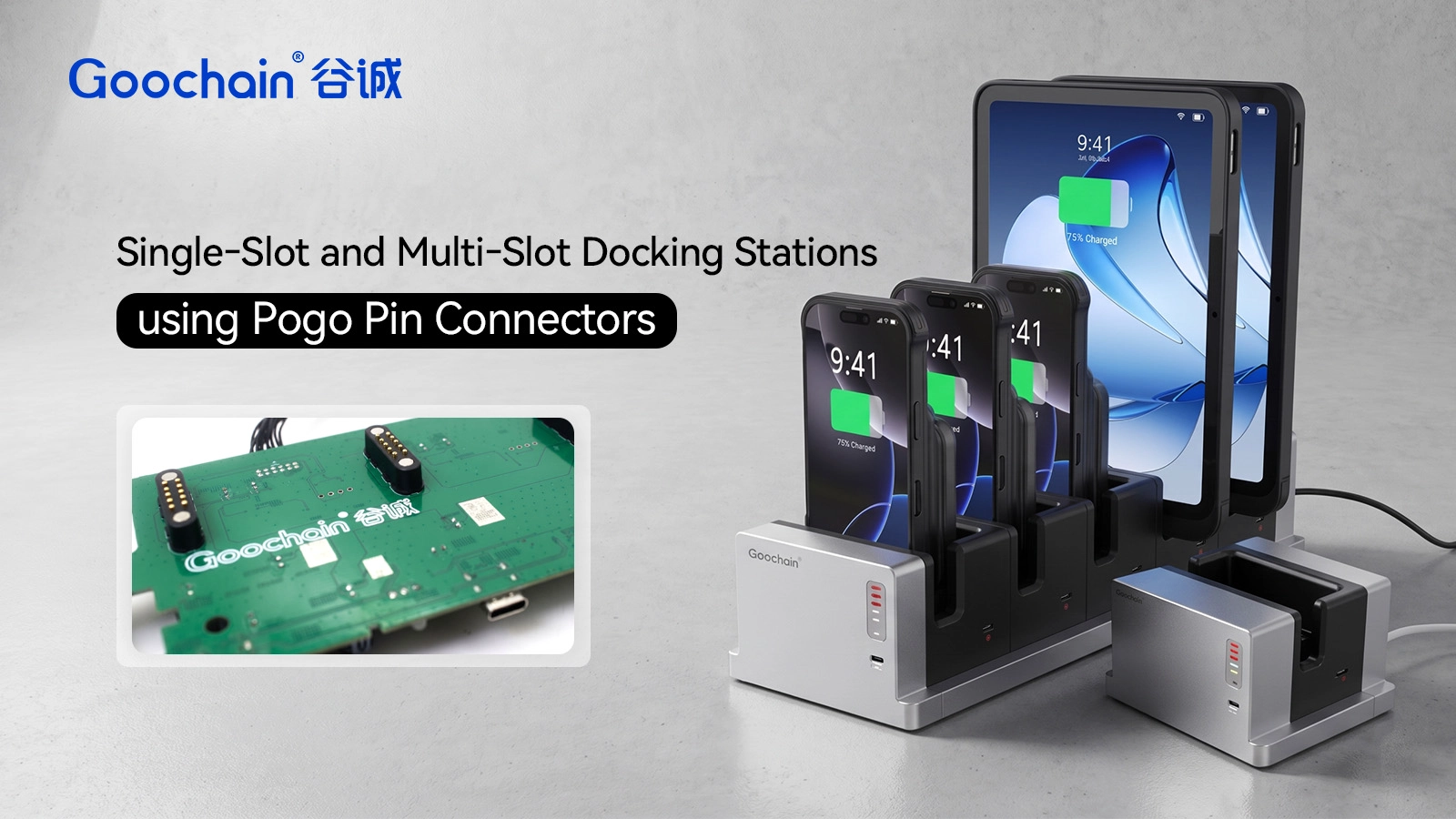
Barcode Scanners and PDAs
Warehouse and logistics devices are docked repeatedly across shifts. A guided connector can support charging, data synchronization and device management without requiring precise plug insertion.
Rugged Tablets and Handheld Terminals
A magnetic or mechanically guided dock can connect a tablet at a workstation, vehicle or field-service base. Custom cases, stands and device-side contact modules can be developed together.
POS and Retail Systems
Tablet POS equipment, payment terminals and self-service devices can use a Pogo Pin dock for daily charging, peripheral connectivity and data communication.
Medical and Diagnostic Electronics
Portable monitors, diagnostic modules and service tools may require reliable docking and controlled cleaning or handling. Materials, geometry, quality documentation and intended use must be reviewed for the specific project.
Industrial and Test Equipment
Removable controllers, test instruments, programming fixtures and data-acquisition modules can benefit from repeatable contact and rapid attachment.
Magnets should assist alignment, not compensate for an unstable housing. Mechanical guides and hard stops should protect the contacts from excessive compression or shear.
When the dock supports USB 5Gbps or 10Gbps, the data path through the dock, cable, Pogo Pin interface and device PCB must be designed as one channel. Pin arrangement, ground reference, shielding, PCB transitions and cable length require engineering review.
See Goochain's USB-C to magnetic Pogo Pin cable for a high-speed round-cable example.
Provide the device model or drawing, dock concept, contact location, docking direction, power requirement, USB speed, pinout, expected cable length, single-slot or multi-slot requirement, environment and expected quantity.
Our Pogo Pin cable customization guide provides a complete RFQ checklist.
Magnetic Pogo Pin connectors can make a docking system faster to use and easier to integrate while combining power, data and auxiliary signals. A reliable design requires coordinated connector, dock, device, cable or FPC, PCB and validation work.
Goochain supports custom docking interconnect development from engineering review and drawings through prototypes, validation and production.


 English
 简体中文
简体中文  Deutsche
  Italian
  français
  Español
  Nederlands
  日本語
日本語  한국어
한국어  عربى
عربى  português
  Türk
Türk 

