




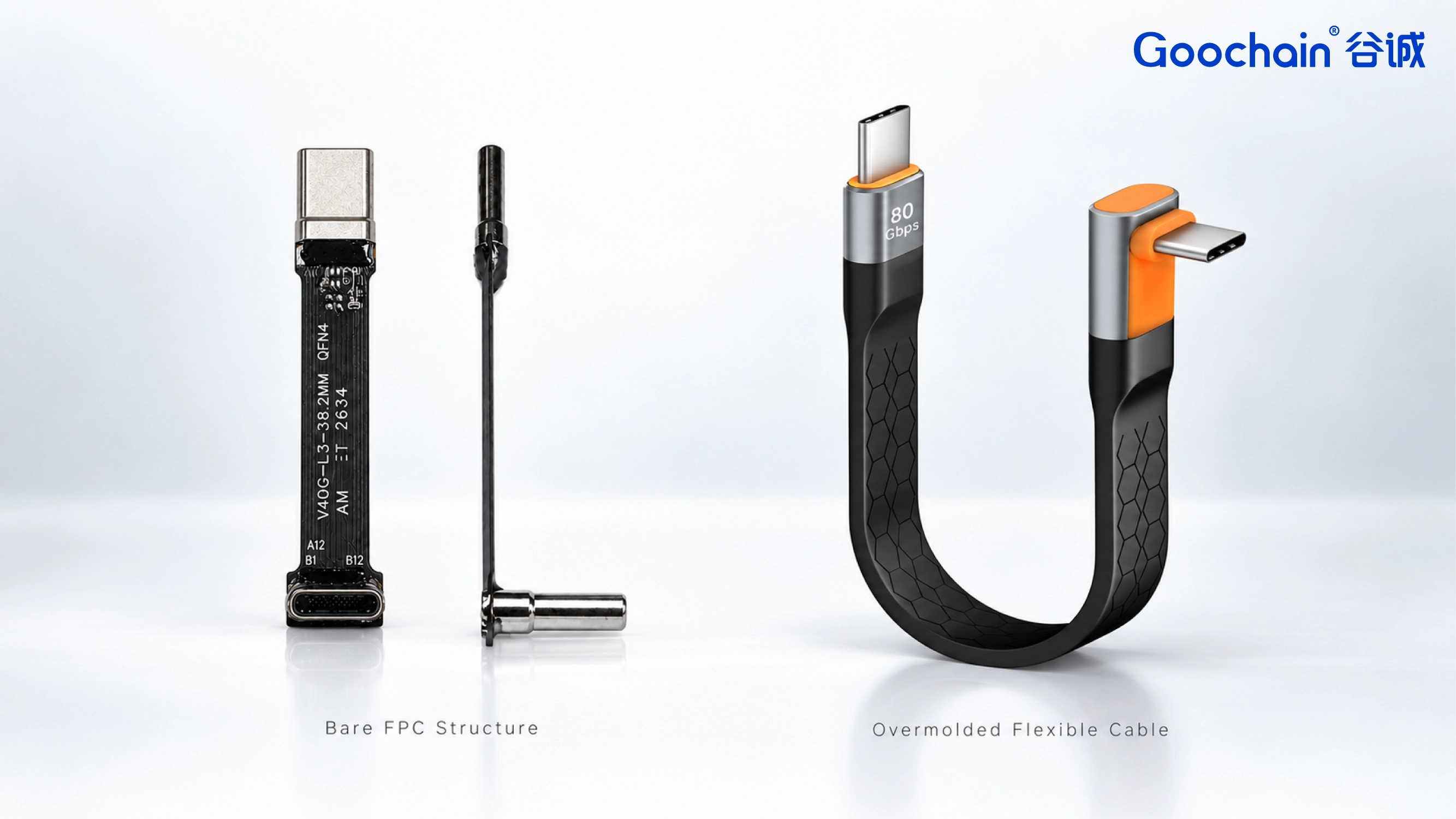
Both an FPC ribbon cable assembly without a full outer overmold and a cable with a molded outer body can use FPC inside. The useful comparison is how each finished construction fits and is handled in the product. Goochain manufactures both forms, so the choice can follow the application instead of being limited to one outer style.
FPC means flexible printed circuit: conductors are patterned on a flexible circuit substrate. FFC generally uses parallel flat conductors within flexible insulation. These terms describe different conductor structures, while flat cable and ribbon cable are broader shape descriptions that do not identify the internal construction by themselves.
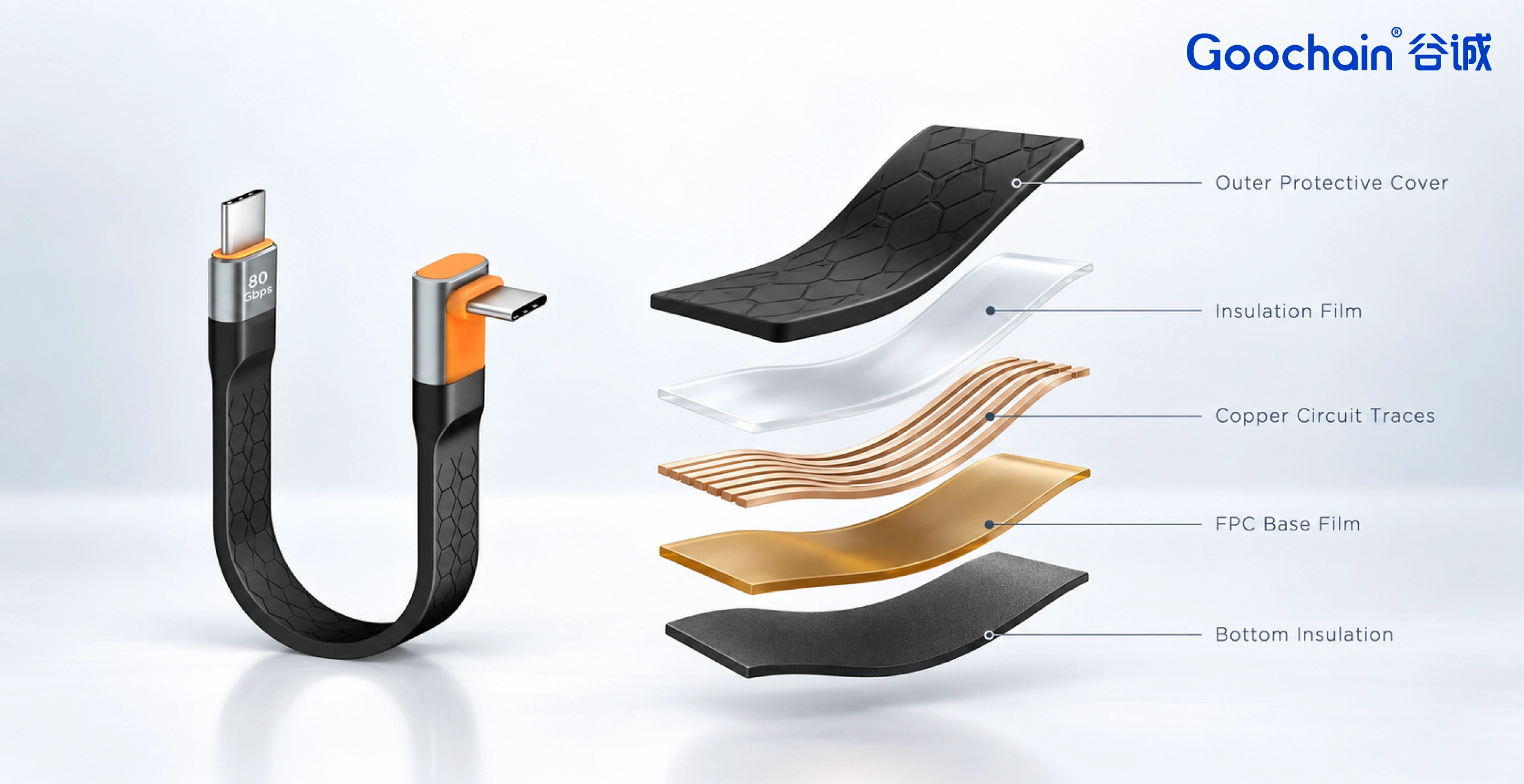
For the Goochain products discussed here, the internal structure is FPC. Bare FPC means an assembly without a full outer overmold, not a circuit with all of its conductors left exposed. The necessary insulating cover layers remain part of the design.
The molded version adds an outer body around the flexible circuit. That can provide a defined handling surface and a finished appearance, but it also adds material to the route. The right choice depends on the whole assembly, including the connector housings.
| Decision | Without a full outer overmold | With a molded outer body |
|---|---|---|
| Routing space | Circuit and local reinforcement define the profile | Circuit plus molded covering define the profile |
| Typical design starting point | Protected internal connection | Visible or handled cable assembly |
| Dimensions to compare | FPC outline and connector transitions | Outer body and molded transitions |
| Mechanical support | Required at loaded connector interfaces | Still required where the installation needs it |
| Data and power | Specified for the electrical design | Specified for the electrical design |
Consider a cable lying beneath an enclosure cover between two fixed modules. If the product already protects the route from handling, the designer may prefer to reserve space for the circuit and its local reinforcement instead of a full outer body. That decision still needs a review of contact with metal edges, assembly access and cable restraint.
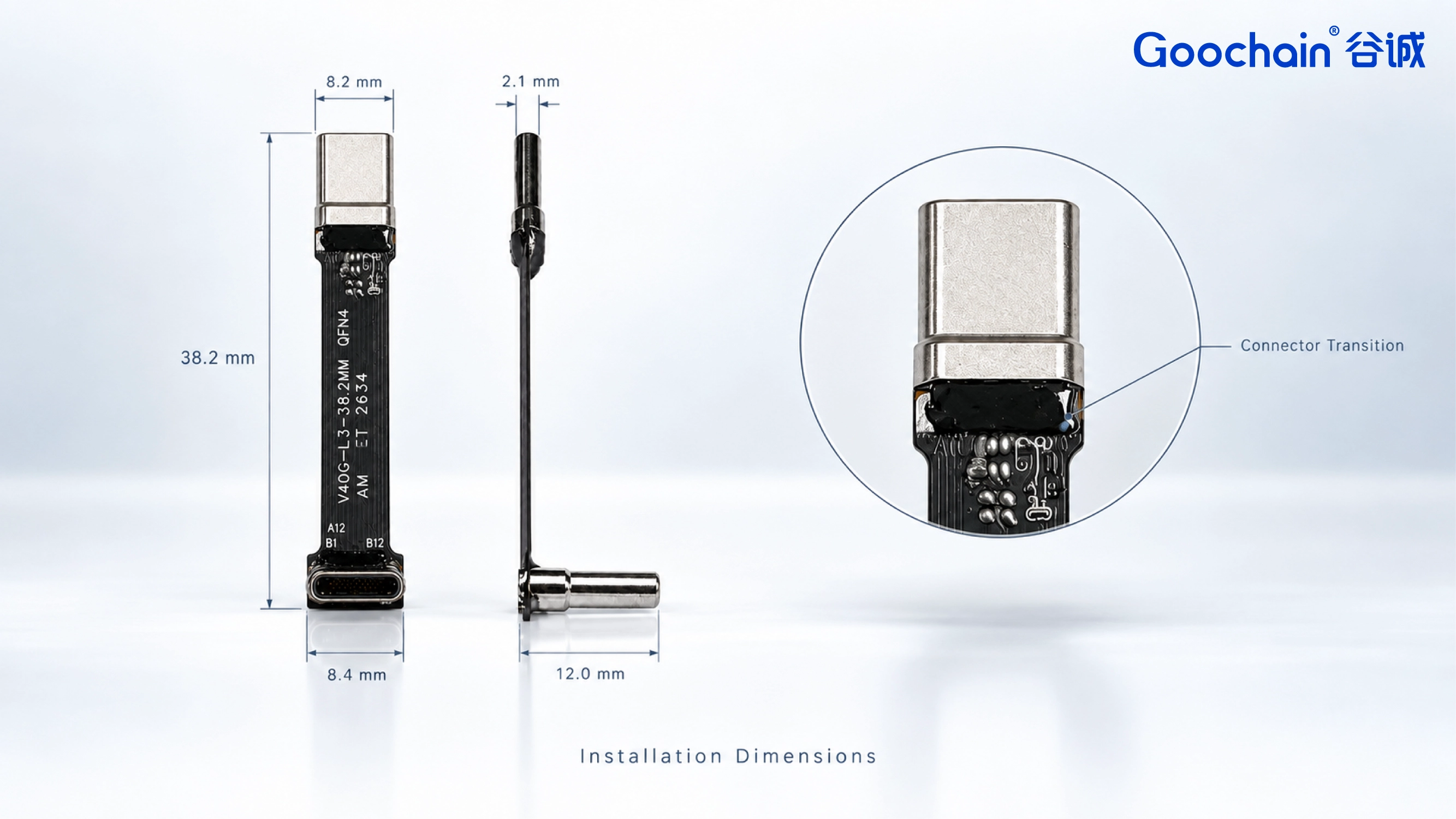
The connector transition can remain the tallest part of the assembly. Check it on a side view with the cover fitted. A thinner flexible section will not solve interference between the cover and a plug housing.
A cable supplied as a finished accessory, exposed between mounted devices or handled during servicing may benefit from a molded outer form. Goochain can develop the covering with the connector housings and the required route. The 40Gbps 240W flat USB-C cable is an example of an FPC-based assembly with an outer body.
Overmolding is not itself a waterproof, abrasion-life or bend-life rating. If the product needs one of those properties, define the material, installation and acceptance test. Avoid treating the appearance of a protective layer as evidence of a tested performance level.
Use the same connector genders, port locations and required functions when comparing the two constructions. Install each sample, close the cover and check access for plugging and servicing. Then evaluate the electrical functions required by the product.
Repeated movement should be stated explicitly. Static and dynamic flex applications have different mechanical requirements, including how the circuit is bent and restrained. A cable that bends during installation is not automatically suited to continuous movement.
Goochain supports connector integration, molding, assembly and sample development. Discuss both FPC construction options with your route and handling conditions so the choice can be made on fit, function and production requirements. You can contact Goochain to request a project review.
Yes. FPC identifies its internal circuit. Overmolded describes the added outer body, so both terms can accurately describe the same cable.
No. The data rate depends on the electrical design and connected equipment. Outer appearance does not establish the supported speed.
Yes. Add the changes you need and the required functions. A reference sample helps explain the form, while a drawing and specification define the production target.


 English
 简体中文
简体中文  Deutsche
  Italian
  français
  Español
  Nederlands
  日本語
日本語  한국어
한국어  عربى
عربى  português
  Türk
Türk 

